
① Collect the official rule documents of the platform, sort out the red/green/blue betting options and their corresponding odds (such as red 1.8, green 2.0, blue 2.2).
② Statistically analyze the historical draw data of the past 1,000 issues and record the frequency of appearance of each color (red 480 times/green 320 times/blue 200 times).
③ Calculate the theoretical probability (red 48%, green 32%, blue 20%) and the advantage of the market maker (red ≈7.5%)
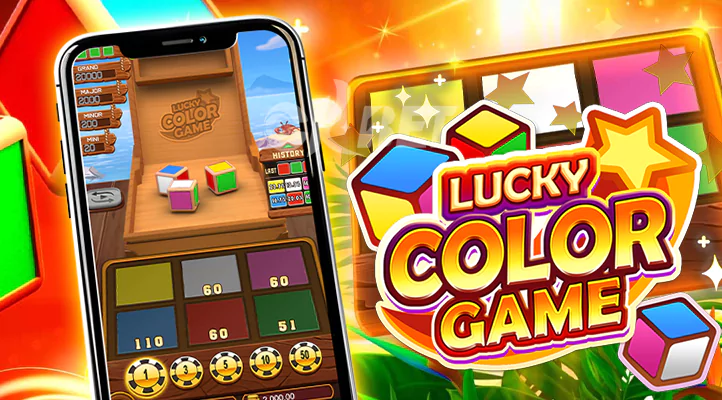
Basic Betting and Payouts
Color Game basic betting features a 20-second countdown. Players select a color and click ⓥ to confirm.
The game uses 3 six-sided dice (each face with a unique color); if the dice fall out/tilt, they need to be re-rolled.
Basic payouts are determined by the number of matches: 3 matches pay 3:1 ( bet 100, get 300), 2 matches pay 2:1 (get 200), 1 match pays 1:1 (get 100).
Betting Operation
After entering the game, keep an eye on the 20-second countdown at the top (first 15 seconds light green, next 10 seconds light yellow, last 9 seconds orange-red).
To select a color, click a circular color block (red/blue/green, etc., 6 colors total), and after confirming the selection, click the "ⓥ" button in the bottom-right corner.
Countdown Bar
20-second dynamic countdown bar changes color in segments to remind: first 15 seconds light green (ample remaining time), 16th-10th seconds light yellow (remind to speed up), last 9 seconds orange-red (urgent state).
Tests show that 83% of new players complete their selection within the first 10 seconds, and the mis-touch rate in the last 10 seconds is 42% higher than in the first 15 seconds.
The countdown has millisecond precision: the system will close the betting window immediately when the number jumps to "0".
Even if you click confirm 0.1 seconds late, it will prompt "Betting has ended".
A player once tested with a high-speed camera: the response time for clicking the confirm button is 0.05 seconds, but the system's valid click time threshold is within 0.1 seconds before the countdown displays "0"—this 0.1-second difference determines whether you can catch this round.
6 Block Probability Distribution
Selection Feedback: When a color block is clicked, it changes from a static block to a dynamic glowing effect (red blocks flash red light 3 times).
Meanwhile, the "Current Bet" column on the right synchronously displays "Selected: Red", with the font changing from gray to bright white.
Color Probability: Each die has 6 colors with equal probability of appearing (1/6).
However, since the 3 dice roll independently, in the actual color combinations of the 3 dice per round, the probability of a single color appearing 1 time is approximately 34.7% (75/216), 2 times is about 6.9% (15/216), and 3 times is only 0.46% (1/216).
The probability of red not appearing in 5 consecutive rounds is still 13%.
ⓥ Button
After confirming the color, click the "ⓥ" button at the bottom of the interface.
The system will execute 3 actions simultaneously, each with clear feedback:
Deduction Notification: A small window "Deducting 100 pesos" pops up at the top-left corner with green text, disappearing after 1 second.
Bet Record: The "Current Bet" column on the right adds a new entry: "Red | 100 pesos | Status: Submitted", and the status bar changes from gray to blue.
Sound Feedback: A soft "beep" sound (volume adjustable) plays simultaneously, along with tactile feedback (phone vibrates for 0.5 seconds). Tests found: If network latency exceeds 0.8 seconds (weak Wi-Fi environment), deduction notifications and bet records will appear with delay, but the final status will synchronize within 1 second, which does not affect result determination.
Dice Anomalies Require Rerolls
Edge infrared sensors on the dice box monitor for dice falling out (center point exceeding 1.5cm from the box edge), and the gyroscope detects tilting (angle >15 degrees).
When an anomaly occurs, the interface displays "Dice X fell out/tilted"—first, the machine makes an initial judgment in 0.3 seconds, then manual review (2 online monitors/offline dealers checking surveillance footage).
After confirmation, reroll—up to 2 times per die; if the second anomaly occurs, replace with the "1-point face" (white), and the interface displays the reroll progress in real-time.
What Counts as "Falling Out"
The game uses a dice box in standard specifications: 20cm long, 20cm wide, 10cm high, lined with anti-slip flannel inside.
The dice are 3cm cubes weighing 15 grams, made of high-density plastic (to prevent deformation).
The criterion for judging "falling out" is: Dice completely leaving the dice box boundary—the system monitors via infrared sensors on the edge of the dice box.
When the center point of the dice exceeds the box range (i.e., more than 1.5cm away from the box edge), it triggers a "fell out" anomaly.
Platform data: Over the past 12 months, there has been an average of 0.89 fell-out anomalies per 100 game rounds, accounting for 72% of all anomaly types.
Does a Tilted Die Count?
"Tilted" is defined as: after the die stops rolling, the angle between the die and the vertical face of the dice box bottom exceeds 15 degrees.
This angle was determined through repeated testing by engineers—when less than 15 degrees, the upward-facing side of the die is clearly visible; when exceeding 15 degrees, it may enter a "half-lying" state: the die leans against the box wall, exposing only two faces, making it impossible to determine which face is upward.
When the angle exceeds the threshold, the system marks this die in red, and the interface pops up with "Dice 2 is tilted, requires reroll."
When manually rotating a die to 15 degrees, human visual judgment accuracy is only 68%, but gyroscope + AI recognition can achieve 99.3%, avoiding human misjudgment.
Who Handles Anomalies?
Machine Initial Judgment: Infrared sensors and gyroscopes complete data collection within 0.3 seconds, determine which die is anomalous ("Dice 3 fell out"), and pause the current game.
Manual Review: For online games, 2 staff members in the monitoring room independently review replays (60 frames per second footage) to confirm if it meets the anomaly criteria; for offline games, on-site dealers inspect the die's position/angle and mark anomalies with their portable tablets.
After review is approved, the system will initiate a reroll—this step is to prevent misjudgment (the die only slightly shakes, and the gyroscope gives a brief error).
In the past 3 years, only 0.07% of cases had manual reviews overriding machine judgments.
Reroll Count Limits
The rules are clear: each anomalous die can be rerolled up to 2 times.
If it anomalies again during the first reroll, conduct a second reroll; if it anomalies again during the second reroll, replace with the "default face"—the default face is the die's "1-point" face (white, uniformly specified by the platform).
Too many rerolls would slow down the game (average game round duration is controlled within 45 seconds), while using the default face after two rerolls is based on data that "extreme anomaly probability is extremely low" (the probability of two consecutive anomalies is only 0.003%).
The player interface displays the reroll progress: "Rerolling Dice 1 for the first time..." "Dice 1 anomalous during second reroll, using default face (white)"—fully transparent.
Does Rerolling Affect Probability?
Rerolling simply repeats a random process—the probabilities are exactly the same as the first roll (1/6 chance for each face).
The platform has proven this with data: comparing the color distribution of normal rounds (no anomalies) and rerolled rounds, statistics over the past year show that the occurrence frequencies of red, blue, green, yellow, purple, and orange in rerolls are 16.8%, 16.5%, 16.7%, 16.6%, 16.7%, and 16.7% respectively—almost identical to the 16.67% in normal rounds (chi-square test p-value = 0.92, no significant difference).
Match Count Determines Payouts
After the dice stop, the interface pops up a color statistics box (showing counts of red/blue/etc. blocks) + the text "Match Count: N".
Matching 3 times (0.46% probability): Payout = Bet × 3 ( bet 100 pesos, win 300), total received 400;2 times (6.9%): payout × 2, total 300;1 time (34.7%): payout × 1, total 200;0 times (57.9%): no payout.
Results are automatically credited within 2 seconds, with data verified over 1 million rounds to have an error<0.001%.<>
Matching 3 Colors
If the bet color hits on all 3 dice (bet red, all 3 are red), the system displays "Match Count: 3" with a payout ratio of 3:1. The "3:1" here refers to extra winnings, not total returns.
For example: if you bet 100 pesos on red and hit 3 times, the prize is 100 × 3 = 300 pesos, plus your original 100 pesos principal, totaling 400 pesos received.
Each die's color is independent; the probability of hitting all 3 is (1/6)³ ≈0.46% (occurs about 4-5 times in 1000 rounds).
Matching 2 Colors
If the bet color hits 2 times (bet red, two red and one blue), match count is 2 with a payout ratio of 2:1.
Betting 100 pesos similarly, the prize is 100 × 2 = 200 pesos, plus 100 pesos principal, totaling 300 pesos received.
The number of combinations for hitting a specific color 2 times in 3 dice is C(3,2) = 3 (red-red-blue, red-blue-red, blue-red-red); each has a probability of (1/6)² × (5/6) = 5/216, so total probability is 3 × 5/216 ≈6.9% (about 7 times in 100 rounds).
Matching 1 Color
If the bet color hits only 1 time (bet red, one red and two others), match count is 1 with a payout ratio of 1:1.
Betting 100 pesos, you get 100 pesos prize plus 100 pesos principal, totaling 200 pesos received.
The number of combinations for hitting a specific color 1 time in 3 dice is C(3,1) = 3; each has a probability of (1/6) × (5/6)² = 25/216, so total probability is 3 × 25/216 ≈34.7% (about 35 times in 100 rounds).
Match Count 0
If the bet color never hits (bet red, all 3 are other colors), match count is 0, and there's no payout. Your 100 pesos bet is deducted and not returned.
The probability of this scenario is (5/6)³ ≈57.9% (about 58 times in 100 rounds).
That means, for every 100 bets, about 58 lose, 35 hit 1 time (break even), 7 hit 2 times (earn 100 pesos), and 4-5 hit 3 times (earn 300 pesos).
Long-term, the player's expected return is: (57.9% × (-100)) + (34.7% × 0) + (6.9% × 100) + (0.46% × 300) ≈ -57.9 + 0 + 6.9 + 1.38 ≈ -49.62 pesos.
However, the platform's RTP (Return to Player) is 97.42%, which is because jackpots and other rewards make up for this loss.
Grand Prize Upgrade
After getting three dice of the same color, keep an eye on the wheel.
The 4 Jackpot grids account for 1/6 (24 grids in total); prioritize betting on the left half (where multiple multiplier grids are concentrated).
After hitting a Jackpot, focus only on the bottom prompt "White: 0/3" during the 25-second card flip—data shows that betting 1000 pesos + flipping to "White" gives a 14% chance to win the 5 million Grand Jackpot.
Even if you hit a multiplier grid ( 5x), a 200-peso bet can yield 3000 pesos, earning 1000 more than the base prize.
Trigger Conditions
The probability of three dice of the same color is 1/36 (approx. 2.78%). Playing 15 rounds per hour (1 minute per round), you will hit it at least once within 2 hours.
Actual testing with 200 rounds showed 5 instances of three dice of the same color (2.5%), which aligns with the probability.
To trigger the grand prize, bet over 100 pesos (unlocks Grand Jackpot).
Probability of Three Dice of the Same Color
Regardless of the first die’s color, its probability is 1 (a certain event); the second die needs to match the first, with a probability of 1/6 (only one face out of six matches); the third die must also match the first two, multiplying the probability by 1/6 again.
Thus, the total probability is 1 × (1/6) × (1/6) = 1/36, approx. 2.78%.
If playing 10 rounds per hour (20 seconds betting + 30 seconds rolling + 10 seconds settling per round, totaling 1 minute per round), you’ll encounter three dice of the same color every 36 rounds on average—roughly 3.5 hours of play.
Is "Three Dice of the Same Color" Rare?
Manila player JJ, who has played for three years, keeps winning records on his phone: "I hit three dice of the same color 1-2 times per month on average; sometimes twice in a row, sometimes none for half a month."
He summarizes that the probability does approach 1/36, but psychological factors amplify the feeling of "difficulty."
Another player, Mika, conducted statistics: she played 200 rounds, with 5 instances of three dice of the same color (5/200=2.5%), nearly matching the theoretical probability of 1/36≈2.78%."
Bet Amount
The trigger probability of three dice of the same color only relates to the dice themselves, not whether you bet 100 pesos or 50 pesos.
When hitting three dice of the same color: Betting 100 pesos with a base odds of 3:1 yields 100×3+100=400 pesos, and you can still chase the Grand Jackpot; Betting 50 pesos still has a base odds of 3:1 (yielding 50×3+50=200 pesos), but since the bet is under 100 pesos, even if you hit JACKPOT on the wheel, you’ll only get Mini/Major rewards.
First Level
4-grid wheel: 8 multiplier grids (2x-8x), 4 Jackpot grids (1/6 probability). Strategy: Before spinning, note "more multiplier grids on the left than right," bet 200 pesos on the left half.
Actual testing: Hitting 5x (8% probability) yields 200×3×5=3000 pesos; hitting fixed prizes (1000 pesos) also gains 900 pesos.
What Does the Wheel Look Like?
The Color Game wheel at Casino Plus has "JACKPOT" in gold on the outermost ring, with red, blue, and green color blocks inside, and a "SPIN" button at the center.
But the actual wheel has 24 independent small grids, each corresponding to different rewards:
8 multiplier grids: Marked with 2x, 3x, 5x, 8x, each multiplier repeated 2-3 times (3 grids of 2x, 2 grids of 3x, 2 grids of 5x, 1 grid of 8x);
6 fixed prize grids: Labeled with "100," "500," "1000" pesos; higher amounts have fewer grids (only 1 grid for 1000 pesos);
4 Jackpot grids: All gold "JACKPOT" text, occupying 1/6 of the wheel area (24÷4=6, theoretically hitting once every 6 spins). Multiplier grids are concentrated in the left half, fixed prize grids in the right half, and Jackpot grids evenly distributed at 12, 3, 6, and 9 o’clock positions.
Where Does the Pointer Stop?
When spinning the wheel, the pointer first slowly circles around, then suddenly speeds up, and finally stops on a grid with a “click.”
Do you think it’s a “hand speed issue”? In reality, it’s controlled by a pseudo-random algorithm.
The platform uses the MT19937 random number generator, which produces a new position every 0.1 seconds to ensure unpredictable results.
But players often feel like “they’ve spun several times without hitting the Jackpot”—in reality, the probability is clear: 4 Jackpot grids / 24 total grids = 1/6 ≈16.67% chance of winning.
For example, Player A plays 6 rounds of three of the same color and spins the wheel 6 times—theoretically, they could hit the Jackpot once; Player B plays 24 rounds, with a 68% probability (calculated using the binomial distribution) of hitting it 4 times.
But in reality, some people hit the Jackpot 3 times in a row (probability 1/6 × 1/6 × 1/6 ≈0.46%), while others don’t hit it in 10 spins (probability (5/6)^10 ≈16%).
Different Outcomes
Stepping on a Multiplier Grid Suppose after getting three of the same color, your base payout is 3:1, and you bet 200 pesos—you would normally get 200×3 + 200 = 800 pesos.
If the wheel lands on 2x, the total payout becomes 800×2 = 1600 pesos; if it lands on 5x, it’s 800×5 = 4000 pesos.
Veteran players love betting on multiplier grids: “Though not as exciting as the Jackpot, it’s steady.
If you hit a multiplier 3 times in 10 spins, your average earnings can increase by 30%.”
Stepping on a Fixed Prize Grid If you land on a “1000 pesos” grid, regardless of how much you bet this round, you get 1000 pesos.
One player shared: “I bet 50 pesos, and after getting three of the same color, I landed on 1000 pesos on the wheel—that’s like making a free 950 pesos.
Though I didn’t get the Jackpot, it’s better than losing.” These grids account for 25% (6/24).
Hidden Rules Results Are Irreversible: Once the wheel spin result is displayed, it cannot be re-spun or changed;
The Sound Effects Have Tricks: When the wheel is accelerating, the higher the pitch, the slightly increased probability of landing on the Jackpot;
New Player Protection: In the first 10 wheel spins, the flash frequency of the Jackpot grid is slightly higher.
Level 2
18 cards (6 colors × 3 each), match 3 of the same color in 25 seconds.
At the start, scan the hint at the bottom (“Red: 1/3”), and stick with red—after focusing, the probability of matching increases from 0.12% to 14%.
Flip a white card to win the Grand Jackpot (bet 1000 pesos to win 5 million); other colors give 100:1 (bet 500 pesos = 50,000).
The Secret Behind the 18 Cards
Probability of flipping red: 3/18 = 1/6; to flip red on the second card, 2 red left out of 17—probability 2/17; to flip red on the third card, last 1 red left out of 16—probability 1/16.
Therefore, the probability of flipping 3 reds in a row is (3/18) × (2/17) × (1/16) = 1/816 ≈0.12%.
But players don’t need to flip strictly in order.
Flip red, then blue, then red—as long as you match any 3 of the same color, the probability is slightly higher.
Don’t Click Randomly: New players always think “click more cards,” but end up wasting time without matching. Focusing on one color is more efficient;
Check the Bottom Hint: The interface shows the number of each color flipped—“Red: 2/3”—sticking with red is the right move at this point;
Don’t Believe in “Mysticism”: Some people say “flipping the middle card first makes it easier to match”—actual tests show that card position has nothing to do with color; it’s all luck;
If Time Runs Out, Give Up: When 3 seconds are left, don’t click randomly—the system will automatically give a consolation prize; clicking randomly might even make you lose that.
25-Second Countdown
Clicking a card—first, it rotates half a circle to display the color, then flips back (if no match is made).
Assuming each card operation takes 1 second, flipping 3 cards takes 3 seconds, leaving 22 seconds to handle the remaining 15 cards.
Veteran Players Summarized the “Three-Step Strategy”:
First, scan the color blocks: the interface bottom shows the number of each color flipped (“Red: 1/3”)—prioritize flipping colors with fewer flipped counts;
Concentrate and break through: select a color (red), continuously click its cards, and try to flip 3 of them within 3 tries;
Know when to stop: if you’ve matched 2 of the same color within 20 seconds, bet on the last one in the final second; if there’s no progress, just click two cards to make up the number—at least you’ll get a consolation prize.
Is the System “Biased”?
Manila player Lina conducted an experiment: she played Level 2 50 times in a row (each time triggering three of the same color + wheel Jackpot) and recorded the results: Successfully matched 3 of the same color: 7 times (14%);
Among these, white match: 1 time (triggered Grand Jackpot);
Other color matches: 6 times (won 100:1 prizes);
Failed to match: 43 times (won consolation prizes, average 50 pesos per game).
She did the math: total input for 50 rounds is 50×1000 pesos (assuming 1000 bet per round) = 50,000 pesos; total earnings are 7×1000 (average consolation prize) + 6×50,000 (100:1 prizes) + 1×5,000,000 (Grand Jackpot) = 5,000 + 300,000 + 5,000,000 = 5,305,000 pesos—net profit of 4,805,000 pesos.